
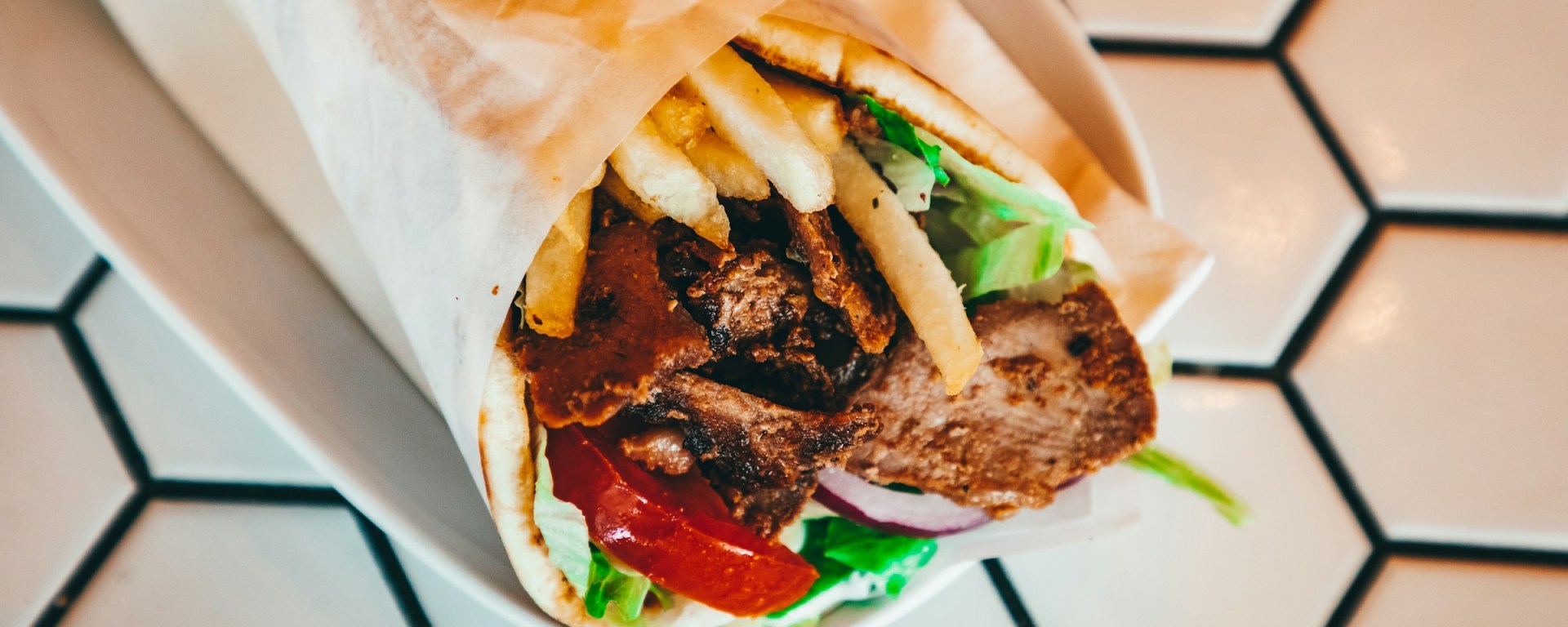
This is how the Greek-Australian diaspora created a new genre of the beloved meat-packed wrap.
First, some housekeeping. What a souvlaki actually is often needs clarification. Souvlaki is the Greek word for skewer, so traditionally, souvlaki is skewered meat cooked over coals or on a grill. The meat is either served on a plate with salad, chips, and dip or in a pita bread wrap.
Souvlaki differs from gyros, which is when pieces of meat are layered up onto a rotisserie, cooked and then shaved off. Like souvlaki, it can be served on a plate with accompaniments or a wrap. In Australia, people often use the term ‘souvlaki’ to also refer to a gyros wrap. This article covers both souvlaki and gyros wraps.
Barbara Santich is an Australian-based food historian and author whose specialty is Mediterranean cuisine. She says the souvlaki would have “slipped in unnoticed with the first Greeks to come to Australia”. This could have been as early as the 1890s.
Santich says during the 1950s and 1960s there was “widespread acceptance of Greek food in Greek restaurants, such as Diethnes, which opened in Sydney in 1952”.
There are multiple factors at play when it comes to how food and cuisines evolve in a diaspora. “It is adapted to prevailing customs,” says Santich. “In America, Italian food was Americanised, enriched with more meat, more cheese, more prestigious ingredients. Thai food is Australianised here – it tends to be sweeter to suit our tastes.”
Meanwhile, she thinks souvlaki had an easy road to acceptance. “A familiar meat – lamb – cooked in a familiar way – grilled. Unless you’re a vegetarian, it’s almost impossible to resist the aroma of chargrilled meat. It is simple, easy to eat, relatively inexpensive and tasty.”
Simple and irresistible yes, but there are some key differences between souvlaki made in Greece and souvlaki in Australia.
Nicole Papasavas runs iconic Greek restaurant Stalactites in Melbourne. Her parents set up the restaurant, which lives in its original spot in the CBD’s Greek precinct 40 years on. It’s renowned for its cave-like interior, inspired by the stalactites of Sparta on Greece’s mainland. Papasavas says the menu has been virtually the same since day dot, which includes Stalactites’ famed souvlaki.
One of the main differences between souvlaki in Greece and Australia is the meat used. In Australia, lamb is extremely popular, but in Greece’s souvlaki landscape, it’s barely seen.
“Lamb was a real delicacy in Greece,” says Papasavas. “You’d only really have it once or twice a year, including at Easter. When my parents came here, lamb was cheap, so that ended up being the meat of choice when it came to making souvlaki. Chicken was an afterthought, we started serving it in the 80s for people that didn’t eat red meat.”
During Greece’s Regime Of The Colonels from 1967 to 1974, the consumption of pork was pushed, which could explain why pork is the most prominent souvlaki meat in Greece today.
The other key difference with an Australian souvlaki is that it’s slightly healthier than a Greek souvlaki. It’s common to see lettuce packed into Australian souvlaki – another thing almost absent in Greece’s souvlaki scene. Lettuce is not a prominent ingredient in Greek cuisine and is more of an Australian influence.
Today, the souvlaki in Greece commonly comprises pork or chicken (or a mix), chips, onion, tomato and sauce, usually tzatziki.
Chips are a semi-recent addition to souvlaki in Greece, says Papasavas, who guesses this change happened in the 2000s. In Australia, restaurants and souvlaki stores are split. Greeks who have recently migrated to Australia may find themselves confused, finding no chips in their souvlaki, but rather, lettuce.
“My parents tried to adapt the souvlaki to the Melbourne palate,” says Papasavas. “It’s a Melbourne business, so the souvlaki is Melbourne-style. My dad says, ‘Greece is where I was born, but Australia is my home’. He would always make souvlaki how people wanted them.”
The customisation of the souvlaki, and the desire for it to be embraced by the Australian people, is perhaps a reason why it was so well received and remains popular today.
Featured image: Anima Visual.
 caterina hrysomallis